
Transforming continuous wireless visibility into operational intelligence.
This is part 3 of 3 of our Wireless Visibility in AI Data Centers Series
- Part 1: Why AI Data Centers Need Continuous Wireless Visibility, explained why AI infrastructure creates a wireless operational environment that traditional cybersecurity tools do not continuously observe.
- Part 2: Why Traditional Monitoring Stops at the RF Edge, explored the operational boundary between infrastructure telemetry and continuously changing wireless activity, demonstrating why organizations require continuous wireless visibility alongside existing security investments.
Continuous wireless visibility, however, is only the foundation. Simply detecting wireless activity does not automatically produce operational understanding. Modern AI infrastructure generates thousands of wireless interactions involving personnel, automation systems, maintenance equipment, operational technologies, and connected devices. Security teams must determine which activity represents expected operations and which warrants investigation. This transition from observing wireless activity to understanding its operational significance defines the difference between wireless visibility and Wireless Airspace Cybersecurity.
Continuous Visibility Is the Beginning, Not the Destination
Continuous wireless visibility provides organizations with awareness of wireless activity occurring throughout AI infrastructure. It continuously observes Wi-Fi, Bluetooth, cellular, and other RF communications that may never traverse enterprise networks or security monitoring platforms. That visibility answers an important question: What wireless activity is occurring right now?
For many organizations, that question alone represents a substantial improvement over traditional approaches. Unknown devices become visible. Unauthorized hotspots can be detected. Unexpected wireless communications can be identified as they occur rather than discovered during periodic audits. Visibility alone, however, does not establish operational understanding.
Knowing that a Bluetooth device appeared in a GPU cluster does not indicate whether it belongs to authorized maintenance personnel, is an approved diagnostic tool, an automation platform, or an unauthorized device introduced into a sensitive environment. Likewise, observing a cellular hotspot does not immediately reveal whether it supports approved maintenance operations or creates an unmanaged communications path around established security controls. Visibility provides observations. Operations require understanding.
From Visibility to Operational Intelligence
Operational understanding develops through multiple layers of analysis that transform observations into actionable intelligence. Continuous wireless visibility first detects wireless activity. Device classification determines what devices are communicating. Behavioral analysis establishes expected operating patterns and identifies meaningful deviations. Operational context explains why activity is occurring by correlating wireless observations with facility operations, maintenance activities, production schedules, or automation workflows. Policy evaluation determines whether observed behavior aligns with organizational requirements, operational procedures, or regulatory obligations. These capabilities together produce operational intelligence.
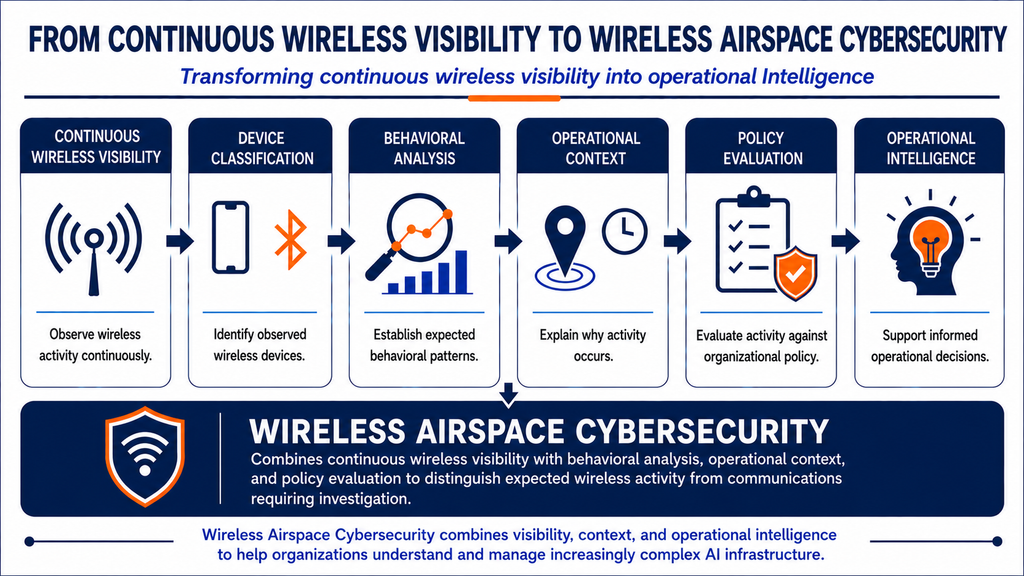
Continuous wireless visibility becomes operationally valuable as organizations combine device classification, behavioral analysis, operational context, and policy evaluation to produce operational intelligence. Wireless Airspace Cybersecurity encompasses this broader operational discipline.
Rather than responding to every newly detected device or wireless transmission, security teams gain the context needed to distinguish expected operational activity from communications that require investigation.
Wireless Airspace Cybersecurity as an Operational Discipline
This progression represents more than an improvement in wireless monitoring. It establishes a broader operational discipline. Wireless Airspace Cybersecurity combines continuous wireless visibility with behavioral analysis, operational context, and policy evaluation to help organizations understand and manage increasingly complex wireless operational environments. Instead of treating every wireless transmission as an isolated event, security teams evaluate wireless activity within the broader operational context of the organization.
For example, Bluetooth communications originating from maintenance equipment during scheduled service windows may represent expected operations. The same activity occurring after hours inside a restricted AI training environment may warrant investigation.
Similarly, temporary Wi-Fi infrastructure supporting approved deployments may be entirely appropriate during installation but unexpected once operations have returned to normal. The difference lies not in whether wireless communications exist, but in whether those communications align with operational expectations.
Why Context Matters in AI Infrastructure
AI infrastructure continues to expand in both scale and operational complexity. Facilities increasingly incorporate autonomous systems, robotics, intelligent building controls, predictive maintenance platforms, environmental monitoring, asset tracking, and connected operational technologies. Personnel routinely move between highly sensitive computing environments while carrying authorized wireless devices that support maintenance, diagnostics, and operational workflows.
These activities generate legitimate wireless communications that continually evolve throughout the operational day. Static inventories cannot accurately represent this environment. Periodic wireless assessments cannot capture continuously changing operational conditions.
Security teams require continuous visibility coupled with operational context to understand how wireless activity relates to normal business operations. Only then can organizations distinguish expected behavior from activity that introduces operational or security risk.
This operational awareness also has broader strategic importance. AI infrastructure increasingly supports advanced research, critical infrastructure, defense programs, and economically significant intellectual property. Foreign intelligence services have consistently targeted strategically important technologies through cyber operations, insider recruitment, supply chain compromise, and physical access. As AI infrastructure becomes a higher-value target, organizations should also consider the possibility that sophisticated adversaries may attempt to exploit unmanaged wireless activity to establish unauthorized communications, collect information, or support broader intrusion objectives. Continuous wireless visibility, combined with behavioral analysis and operational context, helps security teams recognize wireless activity that differs from established operational patterns and determine when additional investigation is warranted.
Supporting Existing Security Investments
Wireless Airspace Cybersecurity complements existing cybersecurity investments rather than replacing them. Traditional security platforms remain exceptionally effective at protecting managed infrastructure, including servers, storage, applications, networks, cloud services, and identities. Continuous wireless visibility extends that understanding into the wireless operational environment alongside managed infrastructure.
Together, these capabilities provide a more complete understanding of modern AI operations by correlating infrastructure telemetry with continuously changing wireless activity. Rather than creating another isolated monitoring capability, Wireless Airspace Cybersecurity expands operational awareness across an increasingly important domain of enterprise operations.
Conclusion
As AI infrastructure continues to evolve, organizations will increasingly depend on wireless technologies to support automation, maintenance, facility operations, and connected systems. Those technologies create a dynamic operational environment that changes continuously throughout the day.
Understanding the environment requires more than simply detecting wireless devices. It requires continuous visibility, behavioral analysis, operational context, and policy evaluation working together to produce operational intelligence. That broader operational discipline is Wireless Airspace Cybersecurity.
Organizations that combine infrastructure telemetry with continuous wireless visibility gain benefits that extend beyond threat detection. Operations teams obtain greater visibility into infrastructure changes and contractor activity. Security teams gain additional context for investigating unexpected wireless communications. Continuous awareness of wireless activity strengthens audit readiness and provides facilities and engineering teams with greater operational insight into the connected technologies supporting AI infrastructure. Together, these capabilities improve operational resilience while helping organizations manage increasingly dynamic environments.
AI infrastructure continues to increase in scale, complexity, and strategic importance. Organizations that understand both their managed infrastructure and their wireless operational environment will be better positioned to support resilient, secure, and efficient AI operations while protecting AI infrastructure that has become increasingly important to economic competitiveness and national security.