Bluetooth quietly connects billions of devices across enterprise, healthcare, industrial, and consumer environments: laptops, phones, medical devices, smart locks, badge systems, wearables, and IoT. Yet it usually operates outside the monitoring and security controls applied to Wi-Fi, leaving most organizations with little visibility into Bluetooth activity. That gap turns an everyday convenience into unmanaged wireless risk, a short-range radio that is hard to inventory, hard to capture, and easy for adversaries to probe.
Quick Facts
- What it is: A short-range wireless technology that connects nearby devices without cables, spanning two stacks: Bluetooth Classic (BR/EDR) and Bluetooth Low Energy (BLE).
- Where it lives: Laptops and mobile devices, badge readers and mobile credentials, medical devices, smart locks and access control, industrial safety systems, conference room systems, wearables, and IoT.
- Spectrum and hopping: Operates in the crowded 2.4 GHz band and uses frequency hopping for reliability, with Bluetooth Classic across 79 channels and BLE across 40.
- Connection stages: Communication generally moves through connecting, pairing, and bonding, with access and risk escalating at each step.
- Why traditional controls miss it: Bluetooth operates outside standard Wi-Fi monitoring, frequency hopping complicates packet capture, and the operating system hides version and encryption details.
- How to detect it: Continuous passive RF monitoring across Bluetooth Classic and BLE to identify, analyze, and localize transmitting devices.
Bluetooth has evolved far beyond simple cable replacement. It now supports critical workflows including physical access, authentication, employee safety, audio, and IoT communication, often outside traditional security controls. In environments with elevated security requirements, it warrants the same scrutiny as Wi-Fi, because its frequency hopping, multiple protocol stacks, and limited enterprise manageability challenge conventional monitoring, compliance, and governance models.
Bluetooth Basics
Bluetooth Classic (BR/EDR)
Built for continuous communication and audio streaming, Bluetooth Classic is common in vehicles, speakers, headsets, and earbuds. It delivers higher throughput at the cost of higher power consumption and operates across 79 channels in the 2.4 GHz band.
Bluetooth Low Energy (BLE)
Designed for low power consumption and short bursts of data, BLE dominates wearables, smart locks, medical devices, trackers, and IoT systems. The radio can sleep most of the time and run for years on a coin cell, using 40 channels that include dedicated advertising channels.
How Bluetooth works
Bluetooth shares the crowded 2.4 GHz spectrum with Wi-Fi and uses frequency hopping to stay reliable, shifting channels constantly. Communication moves through connecting, pairing, and bonding, with pairing methods that include passkey entry, numeric comparison, out-of-band, and “Just Works.”
Watch the Briefing
The following short briefing explains how Bluetooth works, why it spans two very different technology stacks, and why its design makes it a difficult wireless environment to monitor inside the enterprise.
How Bluetooth Expands the Enterprise Attack Surface
Connection escalation
Bluetooth communication escalates through three stages, and access and risk grow at each one. Connecting establishes a basic, often unencrypted link; pairing exchanges keys to encrypt the channel and unlock more services; and bonding stores trusted keys for automatic reconnection. Keys compromised at the bonding stage can grant persistent access.
Exposed BLE advertising
Many BLE devices continuously advertise their presence so they can be discovered. Poor implementations expose device names, firmware details, battery status, and supported services to anyone listening, with no pairing or bonding required to intercept. Free mobile apps can scan nearby devices and surface this metadata.
Weak pairing methods
Pairing trades cryptographic strength for convenience. “Just Works” pairs automatically with zero authentication and is highly vulnerable, while numeric comparison depends on a human actually verifying that numbers match. Devices that rely on these methods for sensitive transfers, or ship outdated Secure Simple Pairing, weaken the entire link.
Difficult to monitor
Bluetooth is effectively a black box compared to Wi-Fi. Rapid frequency hopping complicates packet capture, multiple protocol stacks increase complexity, and the operating system hides version and encryption details. Meaningful visibility often requires BLE sniffers, RF analysis platforms, software-defined radios, or host-level logging, along with the expertise to run them.
Compliance and governance exposure
Bluetooth frequently supports physical access, operational workflows, and IoT communication near intellectual property, protected health information, personally identifiable information, and regulated or classified data. Unmanaged Bluetooth activity can create competitive risk, increase data leakage, and introduce legal or regulatory exposure tied to HIPAA, privacy regulations, contractual protections, or internal policy.
Treating Bluetooth as a Wireless Risk
Bluetooth combines persistent presence, limited enterprise visibility, and proximity to sensitive operations. A version number alone, such as “Bluetooth 5” or “Bluetooth 6,” is a marketing claim rather than a measure of security; implementation quality, certification status, pairing methods, firmware update process, and exposed services determine real risk. Organizations with elevated security requirements benefit from treating Bluetooth as a first-class part of the wireless environment: inventory Bluetooth-capable assets, validate vendor security claims, monitor wireless activity, and restrict unmanaged devices where appropriate.
Addressing Bluetooth Risk with RF Visibility
Managing Bluetooth risk requires visibility that traditional IT and Wi-Fi security tools cannot provide. Bastille delivers 100% passive RF monitoring across Bluetooth Classic, BLE, Wi-Fi, cellular, and other protocols, using a network of software-defined radios to detect, analyze, and localize transmissions in real time. By directly observing wireless activity, Bastille gives security teams visibility into Bluetooth devices regardless of whether they are on the network or enrolled in an MDM, alerts when devices appear in restricted zones, and provides objective wireless data for compliance and audits.
Device fingerprinting
Bastille identifies devices by their wireless behavior and signaling characteristics, distinguishing Bluetooth Classic and BLE devices even when they never join Wi-Fi.
Zone-based alerting
Define RF geofences and trigger instant alerts when a Bluetooth device enters a restricted zone, such as a SCIF, executive space, or data center.
Classic and BLE detection
Detects the specific protocols and advertising behavior that traditional Wireless Intrusion Detection Systems miss, across both Bluetooth stacks.
From the Wireless Threat Series Podcast Episode
Bluetooth Vulnerabilities
Bluetooth Hacking
26 Years of Bluetooth Hacks
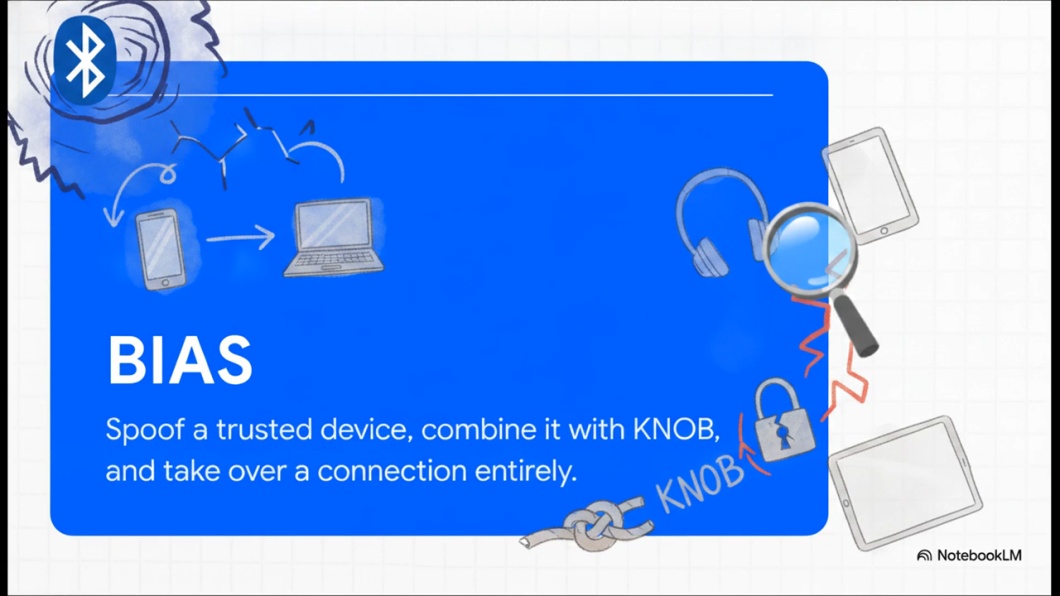
A quick visual history of Bluetooth attacks, from the earliest exploits to today, and why a protocol this long-lived keeps producing new vulnerabilities.
Downloads
Reference material from the Wireless Threat Series on Bluetooth security, free to download and share with your team.
- Bluetooth Vulnerabilities Quick Reference — a two-page guide for security leaders on the visibility challenge, legacy devices, and convenience features that expand the attack surface
- Bluetooth Security Risks Quick Reference — common misconceptions about Bluetooth risk and where the technology actually lives in enterprise environments
- Inside Bluetooth — a slide deck demystifying Bluetooth vulnerabilities, exploits, and enterprise risk, distilled from the podcast
- Illuminating the Bluetooth Attack Surface — a practical primer for security teams on how Bluetooth signaling exposes devices to observation and attack