
Traditional Monitoring Provides Excellent Infrastructure Visibility. AI Operations Require More.
This is Part 1 of 3 in our Wireless Visibility in AI Data Centers Series
- Part 2: Why Traditional Monitoring Stops at the RF Edge
- Part 3: From Continuous Wireless Visibility to Wireless Airspace Cybersecurity
Modern AI data centers represent one of the largest infrastructure investments organizations have ever made. Organizations spend billions of dollars building facilities that support large-scale AI training and inference. Operating those environments requires continuous visibility across compute infrastructure, networking, storage, applications, power distribution, cooling systems, and supporting facilities. Security teams complement that visibility by correlating telemetry from endpoints, identities, cloud services, and enterprise networks. Together, these capabilities provide the visibility required to support AI workloads that demand continuous availability, predictable performance, and resilient infrastructure.
Despite this visibility, one operational environment often remains outside continuous awareness. Wireless communications now support many of the activities required to operate modern AI data centers, including maintenance, facilities engineering, environmental monitoring, intelligent building systems, contractor operations, and infrastructure expansion. Unlike managed infrastructure, the wireless operational environment changes continuously as operations evolve. These changes create an environment that evolves throughout the day.
Wireless communications have become an expected part of AI data center operations. The challenge is maintaining continuous visibility as that environment changes throughout the day and understanding which changes reflect routine operations, planned maintenance, infrastructure expansion, or activity requiring additional investigation.
AI Infrastructure Has Changed the Operational Environment
Traditional enterprise data centers generally evolved at a predictable pace. Infrastructure remained relatively stable, maintenance occurred during scheduled windows, and changes were introduced methodically. Wireless activity reflected that stability because the operational environment itself changed relatively slowly.
AI infrastructure operates differently. New GPU clusters are commissioned while production workloads remain online. Cooling systems expand as rack densities increase, electrical infrastructure evolves alongside computational demand, and construction projects frequently occur within active facilities as organizations continue to add capacity. Equipment vendors, contractors, commissioning teams, facilities engineers, and maintenance personnel often work simultaneously while intelligent building systems continuously optimize facility operations.
The wireless operational environment reflects these changes. Maintenance activities introduce diagnostic equipment and temporary communications. Contractors deploy mobile connectivity during the commissioning of new infrastructure. Environmental monitoring systems, intelligent building technologies, and operational systems continuously exchange information across the facility. Engineering, facilities, and operations personnel move throughout the environment carrying mobile devices that support their work.
Bastille deployments routinely observe wireless activity associated with these workflows that never appears in traditional infrastructure telemetry. Most of this activity represents expected operations rather than security incidents. It is the normal consequence of operating modern AI infrastructure, in which maintenance, expansion, automation, and routine operations occur simultaneously.
Maintaining operational awareness requires understanding more than the performance of managed infrastructure. It also requires continuous visibility into the wireless operational environment supporting daily operations. Traditional monitoring platforms only observed the systems they were designed to monitor, which typically included the wired infrastructure, with partial visibility into the wireless IP network. The wireless operational environment, however, follows a different telemetry model, and traditional monitoring controls often do not apply to it.
Traditional Monitoring Was Designed for Managed Infrastructure
Modern monitoring platforms provide exceptional visibility into managed infrastructure. They continuously monitor the health and performance of compute, storage, networking, applications, cloud services, and supporting infrastructure, enabling operations teams to identify issues quickly and maintain reliable service delivery. AI organizations depend on these capabilities because they provide the operational intelligence required to manage increasingly complex environments.
The telemetry supporting these platforms originates from managed systems. Servers generate logs and performance metrics. Network infrastructure exports operational statistics. Cloud platforms provide service telemetry. Applications produce events and traces that help operations teams understand system behavior. Collectively, these data sources provide a comprehensive view of infrastructure performance and have become the foundation of modern infrastructure monitoring.
The wireless operational environment follows a different model. Many communications supporting AI data center operations occur directly within the RF environment rather than across managed enterprise infrastructure. A Bluetooth diagnostic device communicating with maintenance equipment may never generate enterprise telemetry. A commissioning contractor may temporarily deploy an LTE gateway or 5G hotspot while validating new cooling infrastructure. Building automation systems, environmental sensors, and other operational technologies often exchange information locally without generating events inside traditional infrastructure monitoring platforms.
Organizations can therefore maintain excellent visibility into managed infrastructure while having limited awareness of the wireless operational environment. Traditional monitoring platforms continue performing exactly as intended because they observe the systems they were designed to monitor. Wireless communications often exist outside that telemetry model, creating a different challenge rather than exposing a limitation in existing monitoring platforms.
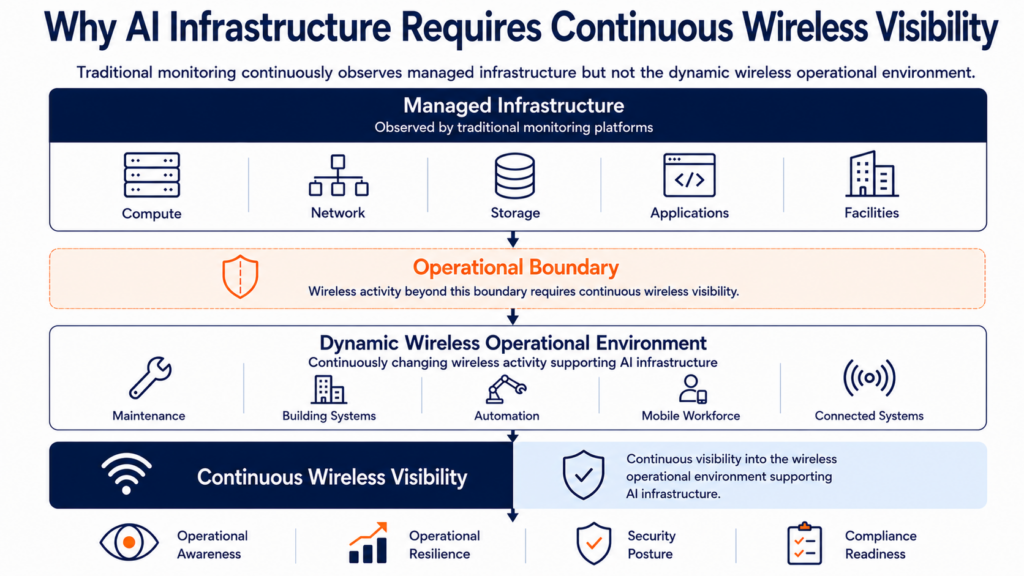
Continuous wireless visibility complements traditional infrastructure monitoring by extending operational awareness into the wireless operational environment that supports AI data center operations.
Infrastructure telemetry explains how managed systems perform. Continuous wireless visibility provides real-time insight into the wireless operational environment surrounding those systems. Together, they provide a more complete picture of AI data center operations.
Continuous Visibility Provides Operational Context
Many organizations assess wireless activity through periodic inventories, scheduled assessments, or project-based surveys. These approaches provide valuable information and often satisfy immediate operational requirements by documenting what devices were present at a specific point in time.
Periodic discovery is no longer sufficient because maintenance activities occur throughout the day. Contractors commission new infrastructure, introduce temporary communications, and remove equipment when projects conclude. Facilities engineers perform routine maintenance using wireless diagnostic tools. Environmental systems continuously exchange information while engineering teams move throughout the facility carrying mobile devices that support daily operations. The wireless operational environment reflects these activities in real time, making it considerably more dynamic than a periodic inventory can capture.
Bastille deployments routinely observe thousands of wireless communications associated with normal enterprise operations that never appear in traditional infrastructure telemetry. Most represent expected operational activity rather than security incidents. The operational challenge is understanding which communications support normal business processes, how the environment changes throughout the day, and when new or unexpected activity warrants investigation. Periodic assessments cannot provide that context because the environment may change significantly before the next scheduled inventory.
Continuous wireless visibility reflects changes in the wireless operational environment as they occur. Instead of describing what existed at a single point in time, it enables operations, facilities, security, and compliance teams to understand how wireless activity changes throughout the day and how those changes relate to ongoing work. That context helps distinguish routine operational activity from communications requiring additional investigation.
Extending Existing Monitoring
Continuous wireless visibility is not intended to replace existing monitoring platforms. AI data centers already depend on mature investments in infrastructure monitoring, application performance management, network operations, and cybersecurity. Those capabilities remain essential because they explain how managed infrastructure performs.
Continuous wireless visibility complements infrastructure monitoring by extending awareness into the wireless operational environment. Together, these capabilities provide a more complete view of AI data center operations by combining infrastructure telemetry with awareness of the wireless activity supporting maintenance, facilities engineering, automation, contractor operations, and day-to-day workflows. Organizations gain additional context without changing the monitoring platforms they already trust.
Continuous Wireless Visibility Supports AI Operations
Wireless communications have become an integral part of operating modern AI data centers. Maintenance, facilities engineering, infrastructure expansion, intelligent building systems, environmental monitoring, and day-to-day operations all contribute to a continuously evolving wireless operational environment. Maintaining operational awareness requires more than periodic inventories or occasional assessments. It requires continuous visibility that reflects operational conditions throughout the day.
That visibility benefits multiple teams across the organization. Operations teams gain better visibility into maintenance activities and temporary infrastructure supporting expansion projects. Facilities engineers obtain additional context for building systems and operational technologies. Security teams improve awareness of communications occurring outside managed networks, while compliance teams gain greater confidence that operational activity aligns with organizational policies and regulatory requirements. Continuous wireless visibility provides a common operational picture that complements existing workflows rather than replacing them.
The importance of this operational awareness extends beyond day-to-day operations. As AI infrastructure becomes increasingly important to economic competitiveness, critical infrastructure, and national security, organizations should also consider the potential for sophisticated adversaries to exploit unmanaged wireless activity. Foreign intelligence services have long targeted strategically important technologies through cyber operations, insider recruitment, supply chain compromise, and physical access. While most wireless activity within AI infrastructure supports legitimate operations, maintaining continuous visibility helps organizations identify unexpected communications that may warrant further investigation before they escalate into a broader operational or security incident.
AI infrastructure will continue to expand, and the wireless operational environment will become increasingly dynamic. Intelligent facilities, automation, robotics, wireless technologies, and mobile systems will continue to increase the volume and complexity of wireless activity that supports day-to-day operations. Maintaining operational context across these environments will require visibility that evolves alongside them.
Where Bastille Fits
Traditional monitoring platforms explain how managed infrastructure performs. Continuous wireless visibility extends operational awareness into the wireless operational environment across AI infrastructure.
Bastille provides that capability through a 100% passive architecture that continuously monitors Wi-Fi, Bluetooth Classic, Bluetooth Low Energy (BLE), LTE, 5G, Zigbee, IEEE 802.15.4, and other RF communications without transmitting RF energy or interacting with production systems. Rather than replacing existing monitoring platforms, Bastille complements them by helping operations, facilities, security, and compliance teams understand how the wireless operational environment changes throughout the day and investigate unexpected activity with additional operational context.
Looking Ahead
Modern monitoring platforms, including SIEM, EDR, NDR, XDR, cloud monitoring, and observability solutions, provide exceptional visibility into managed infrastructure. That capability has become fundamental to operating AI data centers at scale. The wireless operational environment, however, follows a different telemetry model because many communications occur directly within the RF spectrum rather than across managed infrastructure. That distinction explains why continuous wireless visibility has become an increasingly important capability.
If traditional monitoring is supposed to provide comprehensive visibility into managed infrastructure, why does that visibility stop at the RF edge?
The next article, Why Traditional Monitoring Stops at the RF Edge, examines why wireless communications operate outside traditional infrastructure telemetry and how continuous wireless visibility complements existing operational and security investments.