
Understanding Why Continuous Wireless Visibility Complements Enterprise Monitoring
This is Part 2 of 3 in our Wireless Visibility in AI Data Centers Series
- Part 1: Why AI Data Centers Need Continuous Wireless Visibility
- Part 3: From Continuous Wireless Visibility to Wireless Airspace Cybersecurity
Enterprise security teams have never had greater visibility into their managed infrastructure. Modern monitoring platforms continuously collect telemetry from servers, applications, cloud workloads, networks, identities, endpoints, storage systems, and countless other enterprise assets. Security operations centers correlate billions of events each day to detect anomalies, automate investigations, and maintain operational awareness across increasingly complex environments.
Yet modern AI infrastructure introduces a different operational challenge. Alongside the systems organizations actively monitor, there is a continuously evolving wireless operational environment comprising mobile devices, Bluetooth peripherals, LTE and 5G hotspots, building systems, automation equipment, operational technology, maintenance tools, and countless other wireless systems. Many of these devices communicate directly over the RF spectrum without traversing the enterprise infrastructure that traditional monitoring platforms observe, creating an important architectural distinction.
Traditional monitoring platforms provide exceptional visibility into managed infrastructure because that infrastructure continuously generates telemetry. The wireless operational environment often does not. The result is not a failure of today’s monitoring platforms. It reflects how modern wireless communications operate. Understanding this distinction helps explain why continuous wireless visibility has become an increasingly important component of operational awareness for AI infrastructure.
Traditional Monitoring Begins with Telemetry
Every enterprise monitoring platform depends on one fundamental requirement: telemetry. Servers generate system logs. Applications produce transaction records. Identity platforms record authentication events. Network infrastructure exports flow data, routing information, configuration changes, and performance statistics. Cloud services generate extensive operational metadata. Endpoints continuously report process activity, software inventory, security events, and system health. Storage platforms log capacity, access, replication, and performance metrics.
Modern security and operations platforms collect this information continuously because managed infrastructure actively reports its own operational state. Security Information and Event Management (SIEM) platforms aggregate logs from across the enterprise. Network Detection and Response (NDR) solutions analyze network traffic traversing managed infrastructure. Endpoint Detection and Response (EDR) platforms collect telemetry directly from managed devices. Cloud monitoring services continuously gather operational data from cloud-native infrastructure. Identity systems record authentication activity. Performance monitoring platforms collect application and infrastructure metrics.
Although these technologies observe different portions of the enterprise, they all rely on the same architectural principle. Managed infrastructure continuously generates telemetry that monitoring platforms can collect, correlate, and analyze. That architectural model has served enterprise security remarkably well because traditional enterprise communications typically traverse infrastructure designed to observe them.
Two Complementary Visibility Models
The distinction between managed infrastructure and the wireless operational environment is best understood as two complementary visibility models rather than competing approaches to monitoring. This distinction does not reflect a limitation of either approach. Each visibility model monitors different operational environments and uses different sources of information.
Traditional monitoring platforms explain how enterprise infrastructure performs by continuously generating telemetry. Servers, applications, network devices, cloud services, and identity platforms report their operational state, allowing monitoring tools to correlate events, measure performance, identify anomalies, and support day-to-day operations.
Continuous wireless visibility answers a different operational question. Rather than collecting telemetry from managed infrastructure, it observes wireless activity directly in the RF environment. Bluetooth communications, temporary LTE and 5G connectivity, building systems, wireless operational technologies, mobile devices, and countless other RF communications can operate independently of enterprise telemetry yet still influence daily operations.
Viewed together, these capabilities provide complementary operational awareness. Infrastructure telemetry explains the condition of managed systems. Continuous wireless visibility explains the wireless operational environment surrounding those systems. Neither replaces the other. Together, they provide a more complete understanding of AI infrastructure by combining infrastructure performance with awareness of the dynamic wireless environment that supports it.
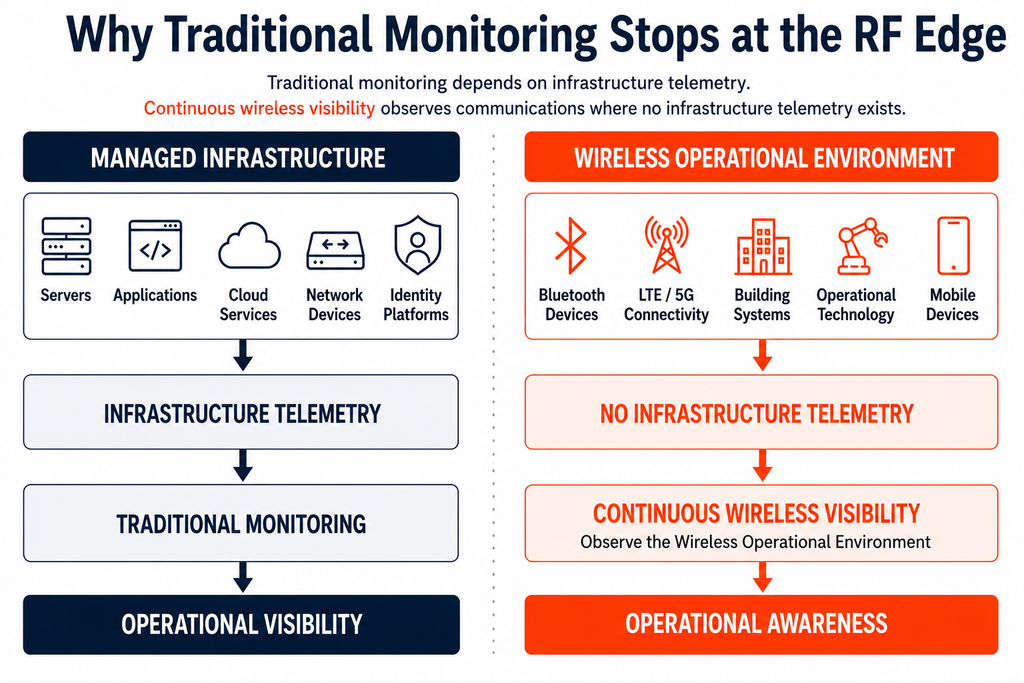
Enterprise monitoring platforms derive operational awareness from infrastructure telemetry, while continuous wireless visibility derives operational awareness from direct observation of the wireless operational environment. Together, they provide a more complete operational understanding of AI infrastructure.
Why Periodic Inventories Cannot Replace Continuous Observation
Organizations have long relied on inventories, wireless assessments, and scheduled surveys to understand their RF environment. These activities continue to provide value by documenting what existed at a particular point in time and supporting asset inventories, compliance initiatives, and configuration validation. They cannot, however, describe how the wireless operational environment evolves between assessments.
Modern AI infrastructure rarely remains static throughout the day. Infrastructure expansion, maintenance, facilities engineering, contractor activity, environmental monitoring, and operational technologies continuously introduce changes into the wireless operational environment. A quarterly assessment cannot capture those changes, nor can a monthly inventory. By the time the next assessment occurs, the operational environment may already be substantially different.
Continuous wireless visibility reflects those changes as they occur, allowing organizations to distinguish routine operational activity from communications requiring additional investigation. The objective extends beyond identifying devices. Organizations need to understand how the wireless operational environment changes over time, how those changes relate to ongoing operations, and when new or unexpected activity warrants investigation.
This continuous operational perspective becomes increasingly important as AI infrastructure grows in scale and complexity. Facilities supporting AI training and inference rarely operate as static environments. Infrastructure teams commission new systems, engineers troubleshoot equipment, contractors perform maintenance, and building systems continuously exchange operational data. These activities routinely introduce new wireless communications that may be entirely legitimate but remain invisible to traditional infrastructure telemetry.
Understanding those changes requires observing the wireless operational environment continuously rather than periodically. Continuous wireless visibility allows organizations to establish a baseline of normal wireless activity, recognize operational changes as they occur, and provide the context needed to determine whether newly observed communications reflect expected operations or warrant further investigation.
Extending Traditional Monitoring
Traditional monitoring platforms remain indispensable because they provide continuous visibility into managed infrastructure. Continuous wireless visibility complements those investments by extending operational awareness into the wireless operational environment rather than replacing existing monitoring capabilities.
Infrastructure telemetry explains how managed infrastructure performs. Continuous wireless visibility explains what is happening within the wireless operational environment surrounding that infrastructure. Together, these provide a more complete operational understanding of AI infrastructure by combining infrastructure telemetry with continuous awareness of wireless activity supporting maintenance, facilities engineering, automation, contractor operations, and routine business activities. Organizations gain additional operational context without replacing the monitoring platforms they already trust.
Looking Ahead
Understanding why traditional monitoring stops at the RF edge explains why continuous wireless visibility has become an increasingly important operational capability for AI infrastructure. Continuous visibility answers the first operational question: What is happening within the wireless operational environment?
Organizations must still determine whether that activity reflects expected operations, violates organizational policy, or warrants investigation. Transforming continuous wireless visibility into operational insight requires more than observing wireless communications. It requires understanding the operational context surrounding those observations and correlating them with the broader environment in which AI infrastructure operates.
This distinction represents the next stage in the evolution of enterprise monitoring. Traditional monitoring platforms remain essential because they provide deep visibility into managed infrastructure. Continuous wireless visibility complements those investments by extending operational awareness into a portion of the environment that enterprise telemetry often cannot observe. Together, they provide a more complete operational understanding of modern AI infrastructure.
As AI infrastructure continues to expand, organizations will increasingly depend on both visibility models. Managed infrastructure telemetry will continue to explain how enterprise systems perform, while continuous wireless visibility will provide awareness of the dynamic wireless operational environment surrounding those systems. Neither replaces the other. Together, they create a more comprehensive operational picture.
The final article in this series, From Continuous Wireless Visibility to Wireless Airspace Cybersecurity, examines how organizations transform continuous wireless visibility into operational intelligence through Wireless Airspace Cybersecurity. It explores how continuous observation, behavioral analysis, policy enforcement, and contextual awareness enable security and operations teams to distinguish expected wireless activity from communications that require investigation, supporting security, compliance, and day-to-day AI infrastructure operations.