

The 2025 television series The Copenhagen Test approaches espionage through a distinctly modern lens. Instead of dramatic intrusions or apparent system failures, the show focuses on a quiet compromise that hides in plain sight. Its central premise, that intelligence analyst Alexander Hale (played by Simu Liu) discovers that his eyes and ears have been hacked and continuously broadcast everything he sees and hears via a covert Wi-Fi signal, reflects a broader reality of today’s technology environments. The most consequential risks often operate silently and unseen, within systems people trust and use every day.
Rather than portraying compromise as a single moment of failure, the series presents it as a condition that persists over time. The threat does not announce itself. It blends into the background, and its power stems from its invisibility. This narrative framework aligns closely with the challenges enterprise security leaders face as invisible wireless connectivity becomes foundational to daily operations.
The Premise as a Security Case Study
The Copenhagen Test follows Hale, an intelligence analyst working within a secretive internal oversight unit tasked with monitoring other intelligence organizations. Early in the series, Hale discovers that an unknown party hacked his eyes and ears through some unknown mechanism. Someone is watching and hearing everything he sees and hears, then uses that information to compromise classified missions and covert sources.
The show centers on Hale’s efforts to continue performing his role while attempting to identify the perpetrator of the hack and to prove his innocence and loyalty. His everyday environments become suspect. Trusted people and processes feel unreliable. The audience experiences a world in which the most significant threat is not an overt breach but the hidden, insidious nature of an uncertain reality shaped by manipulation and perception.
The series deliberately avoids explaining its technology in simple terms, beyond futuristic mentions of nanites in the bloodstream and an unblocked, invisible Wi-Fi signal emanating from Hale’s head. Instead, it emphasizes uncertainty, ambiguity, and the difficulty of maintaining control when influence operates quietly in the background.
Hale’s compromise succeeds because it preserves normal function. He continues to work, communicate, attend meetings, and move through secure environments with very elaborate physical access controls, all without interruption. He triggers no alarms, and his access continues unabated. To outside observers, his behavior appears unchanged.
This aspect of the show is critical. The Copenhagen Test does not frame the compromise as a catastrophic breach or outage. Instead, it shows how surveillance and influence succeed when they coexist with routine operations. Hale’s vulnerability stems from his lack of visibility of the hack and its emanations. He cannot see the transmission, identify who controls it, or determine how the perpetrators use the data. That uncertainty, rather than the technology itself, becomes the core risk.
Enterprise wireless environments create similar conditions. Wi-Fi networks, Bluetooth-enabled devices, mobile phones, LTE and 5G connections, and specialized radios operate continuously across offices, campuses, and industrial facilities. Many of these technologies share overlapping frequency ranges and coexist within the same physical spaces. Without dedicated monitoring, they remain a background layer that security teams overlook.
When Unseen Threats Compromise Operations
A recurring tension in The Copenhagen Test is that the threat remains largely invisible. Hale does not experience a precise moment of compromise, nor does he see evidence of active intrusion. Instead, the compromise is gradual and hidden. The risk remains in the background, operating continuously without disruption until he discovers the intrusion and begins experiencing side effects. What makes the situation dangerous is not a single action, but the steady accumulation of exposure that goes unnoticed.
This dynamic closely mirrors real-world wireless risk. Unauthorized or unmanaged wireless devices need not behave maliciously to pose a risk. Their mere presence can create hidden pathways for data leakage, unauthorized access, or long-term exposure. Because these devices often blend into existing wireless activity, they can persist undetected while gradually revealing operational patterns, personnel behavior, and system dependencies.
The show’s use of Wi-Fi as the transmission mechanism underscores a critical point. Wireless compromise does not require specialized or unfamiliar technology. It can rely on standard protocols used daily in enterprises worldwide. That normalcy makes the threat difficult to distinguish from legitimate activity and makes it easier for security teams to overlook until consequences emerge.
Scale, Persistence, and Enterprise Complexity
As the series progresses, the scope of Hale’s situation becomes harder to contain. The challenge is no longer limited to the initial compromise. The risk persists across locations, relationships, and time. The broadcast follows him everywhere, integrating into his daily workflow and reshaping his interactions without overt disruption.
Enterprises face a comparable challenge at scale. Wireless environments grow organically as teams deploy access points, peripherals, sensors, and mobile devices to support business needs. Over time, these deployments accumulate. Some remain undocumented. Others drift from policy as ownership changes, configurations age, or operational requirements evolve.
Without comprehensive visibility, security teams struggle to distinguish between authorized wireless activity and unknown or unmanaged signals. As with Hale’s broadcast, these signals may persist for extended periods before anyone notices them or questions their presence or intent.
Why Traditional Security Tools Fall Short
One of the most striking aspects of The Copenhagen Test is that conventional safeguards failed to detect the compromise until long after the perpetrators hacked Hale. The systems designed to protect Hale focus on known threats, explicit violations, and direct attacks. The Wi-Fi broadcast fell outside those assumptions, and it was not until the agency obtained a screenshot of Hale’s computer screen from his perspective that it realized he was the source of the intelligence leaks. By that point, the hack had already compromised several operations and clandestine sources.
Traditional enterprise security tools face the same limitations. Network security platforms prioritize wired traffic and managed connections. Endpoint tools assume direct control over the device itself. Neither approach provides comprehensive insight into the surrounding wireless environment.
As a result, organizations may maintain strong controls over what they manage directly while remaining unaware of wireless activity operating just beyond those boundaries. That gap creates conditions where hidden risk can persist and scale.
How Bastille Addresses the Visibility Gap
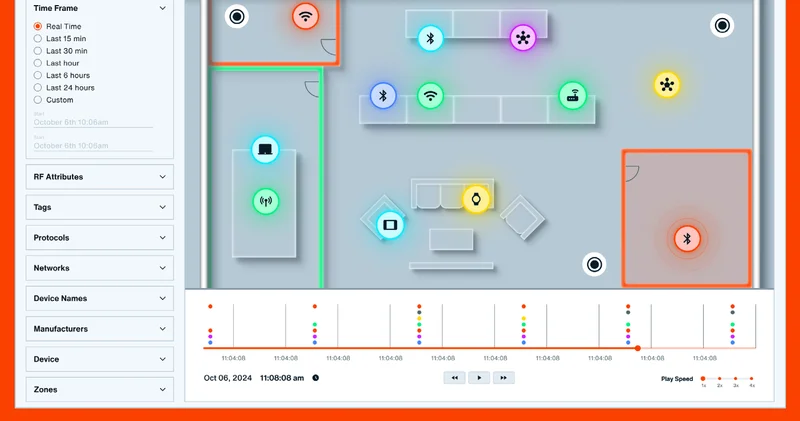
Bastille focuses on making the invisible visible. The Bastille platform provides 100 percent passive monitoring of the wireless environment, allowing organizations to observe wireless activity without transmitting, associating with, or interfering with communications.
By monitoring frequencies from 100 MHz to 6 GHz, and Wi-Fi up to 7.125 GHz, Bastille delivers broad coverage across enterprise-relevant wireless technologies, including Wi-Fi, Bluetooth, and cellular communications such as LTE and 5G. This coverage enables security teams to identify which wireless devices and signals are present within their facilities, regardless of ownership or intent.
Using patented algorithms and analysis, Bastille supports device identification and location estimation. This capability allows teams to investigate unknown or suspicious wireless activity, assess its scope, and respond with informed context rather than assumptions.
In contrast to Hale’s experience, Bastille restores visibility and reduces uncertainty.
The Strategic Lesson for Enterprises
The Copenhagen Test reinforces a fundamental security principle. Risk accelerates when systems operate beyond observation. Hale’s challenge does not stem from a lack of expertise or vigilance. It stems from an incomplete awareness of his situation.
For enterprises, wireless technologies now sit at the center of operations. Treating them as peripheral introduces blind spots that adversaries can exploit quietly and persistently. Addressing this reality requires expanding security strategy beyond traditional networks to include the entire wireless environment.
In this way, The Copenhagen Test does more than entertain. It reflects a real and growing enterprise challenge. Organizations that invest in wireless visibility position themselves to detect hidden risk early, rather than discovering it only after trust and control erode.